Zuzu's Place

Many of us understand that the major enemy of mental health is isolation. Put anyone in isolation for long enough and they will "go crazy." Being alone, and living alone, without vital and healthy connections to other people, leads to fragmentation and breakdown. The opposite is also true - for those of us who have suffered from debilitating emotional or mental distress, a supportive community is a key factor in preventing relapse and in facilitating real recovery.
Unfortunately, creating healthy community can often seem nearly impossible.
Psychiatric survivors frequently find themselves in halfway houses and "group
homes," because these are the only group settings that are open to them
and that can provide the necessary support and companionship that they need.
However these models have many obvious drawbacks. For example, they are frequently
expensive, and most residents can only afford to live in them if a social
service agency pays for them. In addition, when you live in a house that is
run by professional staff, you have no real home of your own - in such a context,
you are constantly reminded that you are a "client" with a label
that says you are not a fully responsible adult. And such supported housing
often enforces a time limit on the length of stay. Once that time has run
out, one's need for a supportive community does not stop. But a person is
then forced out into an apartment to confront the same isolation that was
so devastating in the first place.
What is needed is affordable, permanent, quality housing that provides a setting
in which supportive friendships can develop, while allowing for true independence
and self-determination.
Zuzu's Place
Three years ago, Boston area psychologist Daniel Kriegman really began to
understand the scope of this problem. Dr. Kriegman had been working with Joe,
who had experienced many years of forced medication, locked door seclusion,
and mechanical restraints. He found that this "hopelessly schizophrenic"
man was able to communicate clearly when Dr. Kriegman struggled to understand
what Joe was telling him. Indeed, Joe was able to periodically function at
a very high level as an accomplished graphics designer. But days and sometimes
weeks of living in isolation would inevitably lead to breakdowns.
"It became clear to me," Dr. Kriegman says, "that a few hours a week of understanding and connection could do no more than be a band-aid for people who have experienced profound breakdowns. It is ridiculous to think that you can offer struggling survivors a couple of hours of understanding and then send them back into chaos and emotional isolation and still expect them to heal; it's like believing you can bail the water out of a slowly sinking boat with a thimble."
Eventually, Dr. Kriegman
heard Joe's struggle as a need for belonging in a community of people sharing
life together, not just emotional connection for an hour or two a week. Joe
even went so far as to provide Dr. Kriegman with books and articles describing
such psycho-social healing environments. And so, four years ago, the two collaborated
in trying to find such a place for Joe. They discovered that, apart from a
few such places in Europe, living in a cooperative community - where one isn't
labeled and told how to live by professional staff - is virtually impossible
for anyone who has been given a psychiatric label.
So, Dr. Kriegman put the word out and a group of survivors began meeting to
plan for the creation of such an environment. They held a fundraiser in April
of 2002, which raised $4,000 (with the help of Bob Whitaker, Judi Chamberlin,
M-POWER, and a brilliant performance by folk singer, Don White). In November
of 2002, a down payment was placed on a large house in Whitman, MA and the
first consumer-run cooperative house for psychiatric survivors in the United
States was born. It is called Zuzu's Place.
A Virtual Tour
When visiting Zuzu's Place you will probably immediately be struck, as most
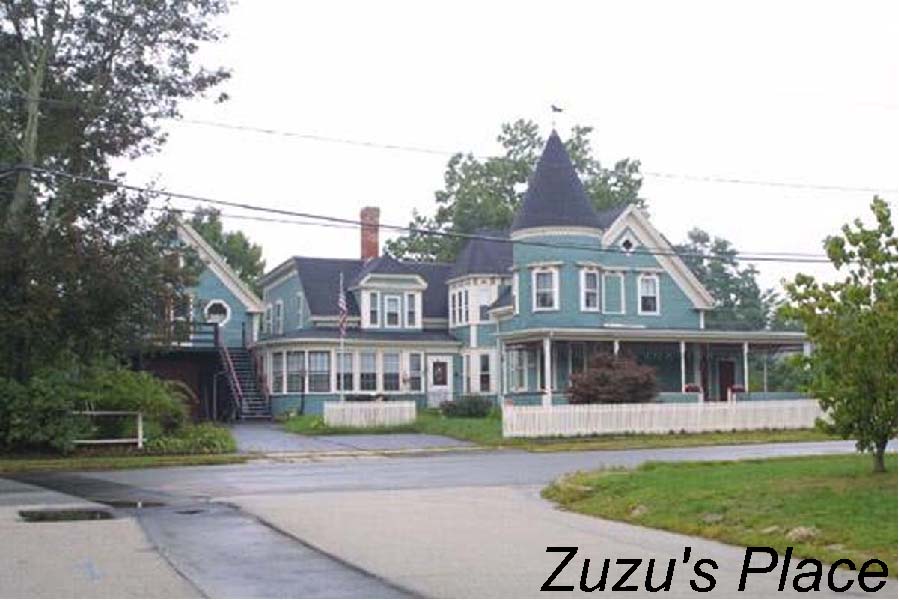
people are, by the size and beauty of the house itself. The two-story house
is a gigantic old farmhouse that has been expanded and improved many times
over the 150 years since it was originally built. Rising out of the front
is a large turret, and underneath this is a spacious covered porch (that has
hosted more than a few summer night barbecues). To the left is an adjacent
garage that was once a barn, the top of which has been converted into additional
living space.
The house is situated on a corner plot of land with yard space for various
activities, including gardening and room for pets to run around. In fact,
as a visitor, the first to greet you upon entering the house would probably
be Jojo, a friendly dog belonging to one of the house members. Jojo can often
be found lounging on the front lawn.
In the entrance room to the house you will notice a place for folks to post
notes and important messages for housemates. Also in this area of the house
are two internet connected computers which are available for anyone's use.
Off to the side is a large and cozy living room with a curved wall of windows
and a working fireplace. This is where the members gather most often, to hang
out, talk or watch movies. There are additional common areas as well, and
two kitchens, one with a large table for members to eat meals together.
As you continue your tour upstairs you will notice that all of the bedrooms
in the house are large and comfortable (all members of the house have their
own private bedroom). Most rooms have ceiling fans and hardwood floors and
were recently wallpapered in preparation for the house's previous incarnation
as a Bed and Breakfast. As you take a look at all eleven bedrooms, you will
probably be amazed at how the house continues to grow, seeming to be even
larger on the inside than it appears to be on the outside. This sense will
only grow as you continue your tour down into the basements (there are two)
where you will notice that there is ample space, offering the possibility
of setting up work or art studios of various kinds, such as woodworking or
photography.
All in all, the house is large and comfortable, with enough room for members
to have plenty of space of their own, as well as ample room where people can
gather to be with one another. Beyond the house itself is the town of Whitman,
a pretty and calm suburb just South of Boston. And if you take a look down
the street from the house, you will find a commuter rail station is only a
four minute walk away, offering reliable and easy travel to downtown Boston.
The Principles
Zuzu's Place is founded on principles of self-determination and empowerment:
the co-op is controlled and run entirely by the members who live in it. This
means that rules about how the house will operate, from who does which chores
to how conflicts are resolved, are established exclusively by the members
of the coop itself. Nobody outside the cooperative can come into the house
and tell the members how they should live or what they should do.
Thus, with no staff and no institutionalized supervision, the professional
psychiatric support that members may need is not connected to the home in
which they live. Still, Zuzu's Place does offer support, in the form of the
community of other housemates, all of whom have either struggled with the
emotional distress that is often labeled "mental illness," or are
open and supportive to those who have. All members are committed to cooperative
living, to being an active member of a cooperative and supportive community.
As a coop, Zuzu's Place is potentially permanent, not transitional. There
are no time limits on how long a person can stay and no member will be asked
to leave as long as they abide by the rules established by the community.
In addition, with low rents, most members can afford to live in Zuzu's Place
for as long as they wish.
These principles allow Zuzu's Place to be a permanent and affordable home
where members can live independently - with the responsibility to care for
themselves and the freedom to make their own decisions - without having to
live alone.
Joining the Coop
There are currently rooms available in Zuzu's Place, and folks are working
hard to get the word out to those who are in need of such an alternative.
But who decides who gets to move in?
Like all the decisions about how the house should be run, decisions about
who lives in the house are made by the members who currently live there. For
anyone considering Zuzu's Place as a potential home, there are a number of
steps.
The first step is to assess affordability and fit of a place like Zuzu's for
you. It is, of course, necessary to make sure one can afford the rent before
considering living in the house. Additionally, it is important to be sure
that one is committed to being an active part of a cooperative community,
and that one can find the sort of professional support one needs (if any)
outside of the house itself.
The next step is for potential members to visit the house and get to know
the current members of the coop. This can occur in one or more relatively
brief visits (or even over the phone, if it is difficult to make multiple
trips to visit the house). After meeting the residents and getting a chance
to know them, one can arrange for an extended overnight stay to get a sense
of life in the house and whether or not one would be comfortable living here.
And finally, if everyone feels that Zuzu's Place is a good fit, there is no
waiting period - one can move in immediately.
Expansion
Those at Zuzu's Place seek to connect psychiatric survivors with one another
so that they can establish their own affordable, supportive homes. As of now,
Zuzu's Place consists of one house in Whitman, MA. However, as this house
gets up and running, it will serve as a model for other cooperatives just
like it. Cooperative housing is one of the best ways for survivors to establish
what the community (and the survivor movement) desperately needs: permanent
and affordable homes that offer support and companionship while allowing for
independence and self-determination. In cooperative homes, members can share
responsibilities and live cooperatively, in charge of their lives, without
the fear that one day their time will be up and they will again have to face
the world alone.
Toward this end Zuzu's Place intends to be just the beginning. As other cooperatives
are created along the same lines as Zuzu's Place, one day soon we will see
a network of cooperative homes across the United States, offering this working
alternative to all who need it.
For more information please contact Josh at (617) 834-5463 or visit www.zuzusplace.org
or email Josh at: contact@zuzusplace.org While Zuzu's Place is currently going
strong, its strength has rested on the shoulders of a lot of people who have
made many contributions both big and small. To insure the ongoing success
of this house and of future houses like it, support of any kind is invaluable.
Even if you aren't looking for such a community, if you would like to support
this effort please contact us!
Zuzu's Place Needs Your Help!
As you have read, we've got a beautiful, furnished, 20-room house, properly
zoned (no small feat) -- but we don't have enough members.
We have to find 11 survivors who want to form a thriving cooperative community.
Unless this happens, the project will run out of funding and a vital and unique
opportunity for the survivor movement will be lost.
You can help us keep this opportunity alive!
1. Contact Zuzu's Place for information on becoming a co-op member, referring others who may want to live in the house, making a donation, or volunteering. Support of any kind is invaluable.
2. Join us on March 26-28th for a conference at Zuzu's Place and help us develop our vision and an action plan to create survivor-run alternatives. Many survivors and their allies will be gathering at this conference, including David Oaks, Judi Chamberlin, and Robert Whitaker! Please join us!
3. With your help, Zuzu's Place can be as important to the survivor movement as the Underground Railroad was to the fight against slavery. Once successful, Zuzu's Place will demonstrate the truth: Loving human relationships are the best way to heal from severe emotional distress.